Indian Startups and YC Founders List
Two weeks back, I came across a comparative bar chart in a linkedIn post for the number of YC Founders from IITs. I became curious to know the implications of being a YC founder. To be honest, the existence of such a list reminded me of Schinder’s List, a famous 1993 historical movie by Steven Spielberg adapted from the novel Schindler’s Ark authored by Thomas Keneally. The novel is based on a German Industrialist Oskar Schindler, who saved thousands of Polish Jews from Hitler’s Holocaust by employing them in his factories. Schindler maintained a list of people he wanted to help. The reader may wonder about the association with Schindler’s List. We will make the connection later. Let us dwell on the contributions of startups in ushering in the 2nd industrial revolution in India.
Early industrialization of India relied on Agri-based products, such as Sugar, Rubber, Cotton, Jute, Textile, and Paper. Manufacturing has never been a strength of Indian Indian industrial sectors. It has a legacy mainly rooted in colonial rule. Pushing drug was central to the economy of the British East India Company (EIC). Opium was cultivated extensively in India’s eastern part (Bihar and eastern UP) under the direct control and supervision of the Opium Department of EIC. Jute, cotton, and sugarcane were other cash crops. By nature, agri-based industries are labor-intensive. According to Statistical abstracts related to industrialization in British India, Jute Mills, and Textile Mills constituted about 20% of factories in India. Metallurgy (mainly steel and aluminum) and chemicals followed later. TISCO was established in 1907. India produced about eighty thousand chemical products, contributing 7% of GDP as of 2022, with a significant contribution from Gujrat. The other segments of Indian industrial products include Machine Tools, Electrical Components, and automobiles. A substantial part of industrial output was dominated by cottage and small-scale industries till 2000. High-end products from Indian industries have primarily depended on borrowed technologies. Apart from the flight of capital outside the country, the supply chain was neither stable nor robust. As a result, the initial phase of India’s industrialization was excruciatingly slow.
After independence, India declared itself a republic and established a multi-party rule through a universal adult franchise. Suddenly, power brokers found themselves orphaned by the colonial system they worked for. It led to a chaotic existential crisis for these elements. The power brokers quickly organized or latched onto political parties. Every political party requires a steady funding source to fight elections and stay in power. Large industrial sectors became a prime target for generating resources. The party in power could extract funds by leveraging new post-colonial licensing mechanisms. However, the opposition is handicapped by the inability to arm-twist industry owners and investors. They created chaos through indiscriminate trade union activities in the grab of safeguarding the rights of workers. It hastened the death of the Jute industry even before it could be modernized or phased out. Besides the Jute, the factories in the industrial belt of eastern India (Kolkata, Howrah, Asansol, and Durgapur) manufactured electrical components, auto parts, and machine tools. However, every industry was affected by trade union activities. Investors were pissed off and decided to bring the shutters down. Wide-spread factory lockdowns and worker retrenchments followed.
A general trend in economic growth is that the share of industrial output to GDP increases with a gradual decline in the share of agricultural output. However, the Indian economy exhibits a different trend. The service sector leads India’s GDP growth. The startup ecosystem in India is mainly building up around the service sector. Flipkart, Zepto, Zomato, Oyo, Ola, etc., are not adding much to India’s manufacturing capabilities. However, many commentators think service sector-led growth is the way forward for the Indian economy. Raghuram Rajan was critical of government efforts to focus on manufacturing. He says that India’s growth should be led by the service sector. There are two main reasons for this trend:
- The low level of education and nonavailability of technically skilled personnel
- Most investors are interested in India’s huge market, not in developing technical capabilities
Almost all technical institutes of repute have an incubation center that allows the hosting and seeding of startups. Everyone hoped that the startup culture now shaping up among India’s technological institutions would give much-needed Industry 4.0 revolution powered by AI, IoT, Robotics, and Computer technologies. However, the ground reality is that only the service sector can employ the workforce with only basic and secondary school education. Therefore, the YC founders from IITs are like a Schindler’s List of technical capabilities. I took time to come to the above conclusion. Recently, I watched a podcast hosted by Nikhil Kamath of Zerodha. India’s startup capabilities are focused on making or branding soft drinks, restaurant business, and aggregation services for anything ranging from hotel and airline bookings to betting and gaming services. Only a few hard-core tech-based startups work in healthcare and assistive living. One or two may be in the financial security and audit system.
Returning to the original discussion thread about YC founders, I noticed Y Combinator invests about USD 500,000 in every company founded by each YC founder. It runs an interesting and unique model that propels YC founders in their endeavors. YC is an American startup accelerator founded in 2005 by the quartet Paul Graham, Jessica Livingston, Robert Tappan Morris, and Trevor Blackwell. It has over 9000 founders in its alum directory. So, we are talking about how many IIT graduates sought help from YC to establish their companies in the USA. I am not sure if any of these companies have an Indian subsidiary or plans to have one in the future. They have an outreach program in 11 countries, including India. However, I found it hard to convince myself why the YC Combinator would be interested in developing deep tech in countries outside the US. There may be two possible reasons for this:
- The technology developed by the startup is based on a potentially earth-shattering idea or
- It can quickly generate capital inflow for the work YC is doing in the US.
Ultimately, a business model cannot survive with a philanthropic model unless the wealth generation is missing. One thing I found missing in a LinkedIn post is the number of resident founders in India. YC directory lists six India-based companies: Razorpay, Zepto, Meesho, Groww, RedCarpetUp, and DripCapital. Four work in the fintech service, and two (Meesho and Zepto) in the e-commerce area. Therefore, YC founders in India contribute hardly anything to building technical capabilities. Let me expand a bit on the list before discussing its impacts to influence serious watchers interested in the potential of India’s manufacturing capabilities.
The comparative barchart post on YC founders from IITs suggests IIT Bombay has a better entrepreneurial ecosystem than others. Is that the case? The IIT Bombay alum network is as strong as the networks of alums at other IITs in supporting entrepreneurial ventures. Ashok Misra, one of the ex-directors of IIT Bombay, was the chairman of Intellectual Ventures for some time after demiting his office. He was also on the board of Directors of Reliance Ltd while holding the IITB’s office of the Director. Prof Mishra was the Director for two terms. It had some influence in networking IIT Bombay alums with investors and venture capitalists. However, this alone may not affect building an echo system for startups. IIT Madras has consciously created an ambiance for startup culture with its industrial park. Satyam operated inside the IIT Madras campus before Ramlinga Raju’s massive financial embezzlement destroyed the company. IIT Kanpur or IIT Kharagpur has not proactively encouraged entrepreneurial activities until very recently. The reason IIT Kharagpur has similar success as IIT Delhi is that it has the largest student intake among the older IITs and has a lot more engineering disciplines that are not found in other IITs. The culture of startups in the country was primarily a recent phenomenon when the government- backed a movement for make in India following COVID-19-related economic depression. Almost 70-75% of the professors in the CSE department at IIT Kanpur worked in theory. One often repeated quote about the department is that these professors are “mathematicians masquerading as computer scientists.” So, deciding to go for a startup for IIT Kanpur was difficult for the CSE students unless one is obsessively fixated.
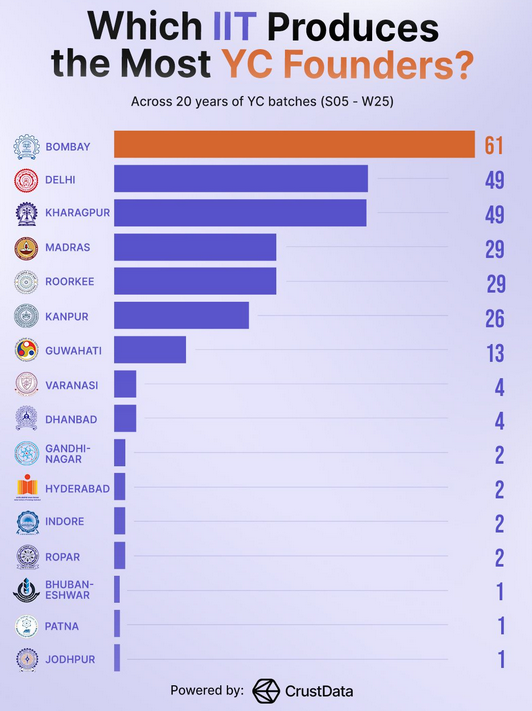
Before wrapping up this post on YC founder, I’d like to make a few points about leveraging the startup ecosystem to build the country’s push toward Industry 4.0. The commerce minister stirred a hornet’s nest in his recent comment on Indian startups. Mohandas Pai immediately jumped on to defend the startups. Both sides have some valid points. The government has yet to redeem itself from its colonial legacy in policy making.
- Many government policy decisions are not helping.
- Instead of criticizing, the minister should make a policy introspection.
- Complex web of tax laws, GST, and other clearances to run an enterprise.
- The “bureaucratic muscle is still strong” (euphemism intended)
We Indians love to talk a lot. My post is also “one more addition.” However, let us make an honest and non-judgemental call on the topic. There was a space for every service startup that has succeeded. Flipkart (sold to Walmart) and many others may have changed hands. Yet some entrepreneurs like Sridhar Vembu could successfully build a 5000cr tech enterprise, Zoho, from scratch. No investors (including the infamous Soros) would like to lose unless it was unavoidable. So, an exit plan is an integral part of any new investment. Therefore, there is nothing wrong with having an exit plan before starting a venture. However, there is a need for well- founded, technically sound metrics to evaluate a startup idea rather than viewing it like a reality show on TV. Well-established Indian companies do not invest much in R&D. They can access CSR routes to fund R&D. However, they use CSR funds to establish a self-controlled educational institution. It serves multiple purposes:
- They can use tax concession to account for loss
- Use the institute to accommodate requests from bureaucrats and politicians
- Showcase the efforts in building educational institutes for social influences and publicity.
However, why do industrial houses spend a lot on buying IPL teams? I am told a small logo on the bat of a well-known player could be as expensive as 12.5 corers. With that money, we can build a lot of infrastructure at a government school. Around the IPL ecosystem, gaming apps sell merchandise and many other businesses. So, individual profitability is at the center stage rather than in institution building.